


There isn’t really a single traditional girl’s name that translates literally to “survivor” in most of the world’s languages. What does exist is a wide, cross-cultural vocabulary of names tied to life, strength, endurance, victory, courage, protection, and renewal, plus a long list of biblical, historical, and mythological women whose stories are about surviving hardship, even when their names themselves mean something more ordinary, like “bee” or “pleasantness.”
This guide keeps those two things separate on purpose. For each name you’ll find:
- Meaning: the name’s documented, literal etymology
- Origin: its linguistic root
- Connection: how it relates to survival, strength, or resilience (literal, symbolic, or through a story)
Where a meaning is genuinely debated among linguists, that’s noted rather than smoothed over. Where a “survivor” connection is symbolic rather than literal, that’s noted too. Below are more than 125 unique names organized into practical categories.
What to Look for in These Names
Literal vs. symbolic. Some names mean “strength” or “victory” outright in their original language. Others carry a survival theme only through association: a plant that thrives in harsh soil, a goddess linked to war, a woman in scripture who rebuilt her life after loss. Both are legitimate reasons to choose a name; they’re different kinds of meaning, not different tiers of it.
How settled the etymology actually is. Many older names, especially Old Norse, Old Irish, and ancient Egyptian ones, have reconstructed meanings that scholars still debate. That doesn’t make them bad choices; it just means a confident “this definitely means X” claim on a baby-name site is often more certain than the linguistic evidence supports.
What actually matters to you. Does cultural origin matter, or not at all? How does the name sound with your last name, said out loud rather than read on a page? Does it need a nickname? How does it sit beside a sibling’s name? There’s no universal right answer, just know which you’re prioritizing before you start narrowing.
Girl Names Connected to Life, Renewal & Rebirth
| Name | Meaning | Origin | Connection |
| Zoe | Life | Greek | Literal |
| Vivienne | Alive, full of life (from Latin vivus) | Latin, via French | Literal |
| Eve / Chava | Life, living one | Hebrew | Literal; root of the biblical phrase “mother of all living” |
| Eva | Variant of Eve | Hebrew/Latin | Literal |
| Chaya | Life | Hebrew | Literal |
| Vita | Life | Latin/Italian | Literal |
| Vida | Life | Spanish, from Latin | Literal |
| Aviva | Spring; also used to mean “fresh” or “renewed” | Hebrew | Symbolic renewal, tied to the season of new growth |
| Anastasia | Resurrection, one who rises again | Greek | Literal renewal meaning |
| Renata | Reborn | Latin | Literal renewal meaning |
| Nova | New | Latin | Not a strength meaning; often chosen symbolically for a fresh start |
| Phoenix | Not a traditional etymological name-meaning; this is the name of a mythological bird | Greek mythology | Symbolic: the phoenix is reborn from its own ashes |
Girl Names Meaning Strength, Might & Valor
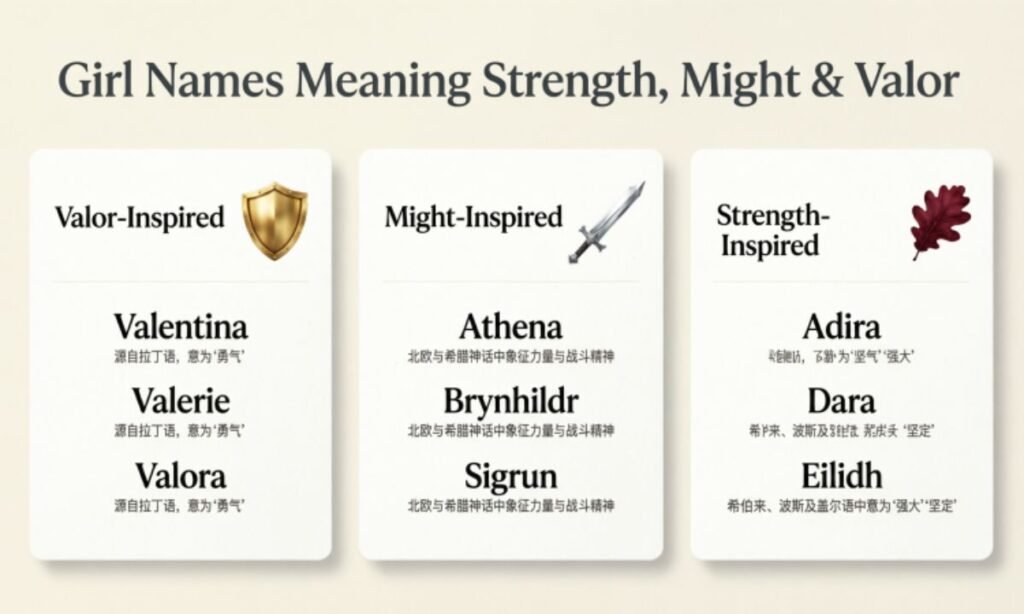
| Name | Meaning | Origin |
| Matilda | Mighty in battle (from maht, “might” + hild, “battle”) | Germanic |
| Valentina | Strong, healthy (from Latin valens) | Latin |
| Valeria | Strong, valiant | Latin |
| Valerie | Strength; French form of Valeria | Latin, via French |
| Adira | Strong, noble, mighty | Hebrew |
| Audrey | Noble strength (from æthel, “noble” + thryth, “strength”) | Old English |
| Audra | Independent variant of Audrey, also used as a standalone Lithuanian name | Old English/Lithuanian |
| Millicent | Derived from roots generally glossed as “work” and “strength,” commonly rendered “industrious strength,” though the compound is reconstructed rather than certain | Old French/Germanic |
| Millie | Short form of Millicent, Amelia, or Mildred | Germanic/English |
| Gertrude | Spear of strength | Germanic |
| Wilhelmina | Resolute protection; feminine form of Wilhelm | Germanic |
| Valda | Linked to Old Norse vald, “power” or “rule” | Old Norse |
| Constance | Constancy, steadfastness | Latin |
Girl Names Connected to Victory & Triumph
| Name | Meaning | Origin |
| Victoria | Victory | Latin |
| Nike | Victory; name of the Greek goddess of victory | Greek |
| Nikoletta | Victory of the people (from nike, “victory” + laos, “people”) | Greek |
| Bernice | Bringer of victory (from Greek pherein, “to bring” + nike, “victory”) | Greek |
| Zafira | Victorious, triumphant | Arabic |
| Boudica (also spelled Boudicca) | Derived from the Brittonic word for “victory”; also the name of the first-century warrior queen who led a revolt against Rome | British Celtic |
Girl Names Meaning Warrior, Protector or Defender
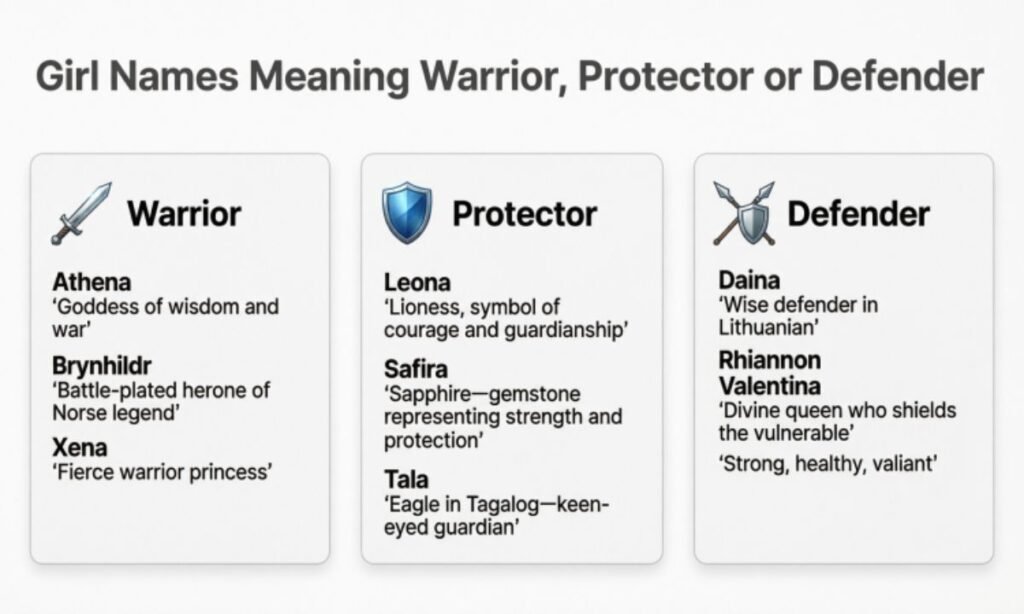
Many of these come from Old Norse and Germanic roots, where hild (“battle”) and gunnr (“war”) appear again and again in older naming traditions.
| Name | Meaning | Origin |
| Alexandra | Defender of the people / protector of man | Greek |
| Alessandra | Italian form of Alexandra | Greek/Italian |
| Louisa | Renowned warrior, famous in battle | Germanic, via French |
| Hildegard | Battle stronghold (hild, “battle” + gard, “enclosure”) | Germanic |
| Brynhild (also spelled Brunhilde) | Commonly parsed as “armor” combined with “battle” | Old Norse/Germanic |
| Griselda | Often translated “grey battle maiden,” though the “grey” element of the compound is disputed by linguists | Germanic |
| Camilla | Traditionally linked to a Roman ceremonial-attendant title (camillus); in Virgil’s Aeneid, Camilla is a legendary warrior maiden, a literary association, not the word’s etymology | Latin/Roman mythology |
| Gunhild | Combines Old Norse gunnr (“war”) and hildr (“battle”) | Old Norse |
| Sigrun | Generally parsed as “victory” (sigr) plus “secret/rune” (rún), often rendered “victory rune” | Old Norse |
| Ragnhild | From roots meaning “counsel” and “battle” | Old Norse |
| Hervor | Meaning uncertain, likely tied to Old Norse roots for “army”; name of a legendary shieldmaiden in the Hervarar Saga | Old Norse |
| Brianna | Feminine form of Brian, whose own etymology is unsettled among scholars, commonly glossed as “noble” or “strong,” but not firmly established | Irish/Celtic |
Girl Names Connected to Courage & Fearlessness
| Name | Meaning | Origin |
| Andra | Feminine form related to Greek andreia, “courage” | Greek |
| Andrea | Manly, courageous (from andreios) | Greek |
| Leona | Lioness | Latin |
| Leonie | Lioness | French/Germanic |
| Kenna | Meaning debated; often connected to Scottish clan names related to Kenneth, glossed as “comely” or “handsome.” The popular “born of fire” claim circulates widely online but isn’t well-documented | Scottish Gaelic |
| Ottilie | From a Germanic root meaning “wealth” or “fortune,” the same root behind Otto. Sometimes glossed online as “prosperous in battle,” but there’s no documented link to battle | Germanic |
| Devora | Bee; the original Hebrew form of Deborah | Hebrew |
Names Symbolically Tied to Survival
| Name | Meaning | Origin | Connection |
| Sabra | A term for a native-born Israeli; the exact linguistic root is debated | Hebrew | Symbolically linked to the sabra cactus fruit, thorny outside, soft inside, known for thriving in harsh desert conditions |
| Bree | From the Irish brígh, meaning “strength” or “vigor” | Irish | Literal |
| Tikvah | Hope | Hebrew | Literal |
| Emunah | Faith | Hebrew | Literal |
| Gabija | Keeper of the flame; a guardian spirit who protects the hearth in Lithuanian folklore | Lithuanian | Mythological, tied to protection |
Short & Modern Names With Strength-Related Meanings
| Name | Meaning | Origin | Pronunciation |
| Hope | Hope | English (virtue name) | HOHP |
| Nadia | Hope (Slavic root); a separate, unrelated Arabic name Nadia means “delicate” or “caller” | Slavic | NAH-dee-ah |
| Vera | Commonly linked to the Slavic word for “faith”; sometimes also connected, likely coincidentally, to the Latin verus, “truth” | Slavic | VEH-rah |
| Asha | Hope (Sanskrit); a separate Swahili name Asha means “life” | Sanskrit/Swahili | AH-shah |
| Endurance | The ordinary English word; historically used as a virtue name by Puritan and Quaker families | English (virtue name) | en-DUR-ans |
| Brave | Courageous; more commonly used as a middle name than a first | English (word name) | BRAYV |
| Ivy | The ivy plant | English | EYE-vee |
| Iris | Rainbow; from the Greek goddess who personified the rainbow | Greek | EYE-ris |
| Gale | Strong wind | English (word name) | GAYL |
| Kaya | Widely cited as meaning “rock” in Turkish; also popularly attributed as a Hopi word for “wise child,” though that attribution is disputed and not well documented | Turkish / disputed Native American attribution | KY-ah |
| Neve | Often used as an anglicized form of the Irish Niamh, meaning “bright” or “radiant”; occasionally connected by folk etymology (not a real derivation) to the Latin word for “snow” | Irish | NEV |
Biblical Girl Names Connected to Survival & Strength
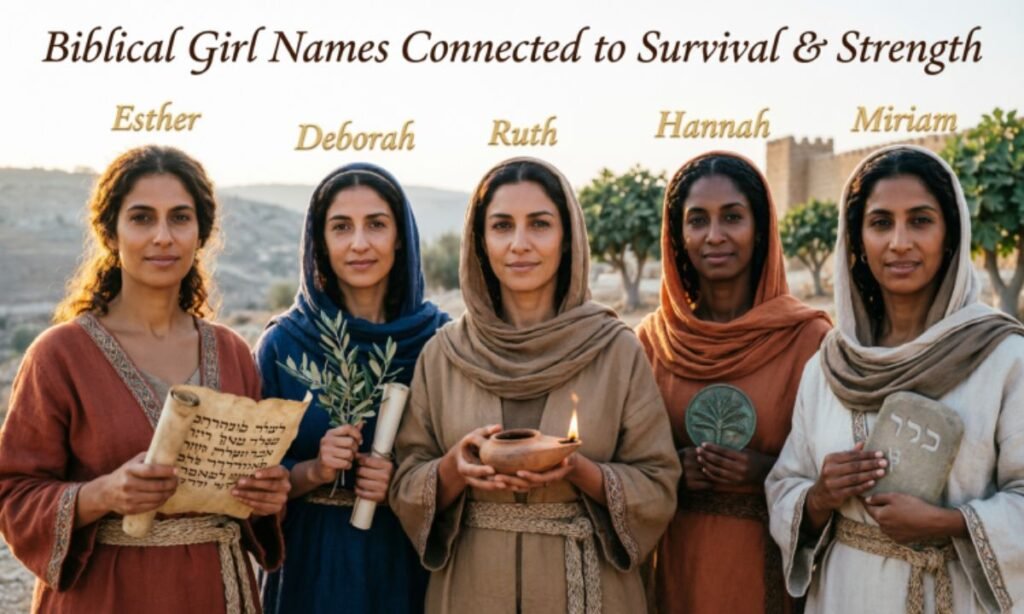
A name’s meaning and a woman’s story are two different things, a distinction the Bible’s women make especially clear.
| Name | Meaning | Biblical Connection |
| Deborah | Bee | Judge and military leader who led Israel to victory in battle |
| Judith | Woman of Judah/Judea | In the deuterocanonical Book of Judith, she saves her town by killing the invading general Holofernes |
| Esther | Meaning debated between Persian and Hebrew roots; often glossed as “star” | Concealed her identity to save her people from destruction |
| Tamar | Date palm | A tree associated with uprightness; Tamar endured betrayal and injustice and was later honored for her resolve |
| Naomi | Pleasantness | Endured famine and the loss of her husband and sons, then rebuilt her life |
| Ruth | Meaning uncertain, often glossed as “friend” or “companion” | Left her homeland and survived as a widow in a foreign land |
| Jael (also Yael) | Mountain goat, ibex | Known for a decisive act of courage during wartime |
| Miriam | Meaning uncertain; suggested readings include “bitter” and “beloved,” with origin debated between Hebrew and Egyptian | Protected her infant brother Moses and helped ensure his survival |
| Shiphrah | Commonly glossed as “beautiful” or “fair” | One of the midwives who defied Pharaoh’s orders to save Hebrew infants |
| Rahab | Meaning debated, possibly related to “wide” or “broad” | Protected spies at personal risk and survived the fall of Jericho |
| Hagar | Meaning uncertain; sometimes linked to “flight” | Survived exile in the wilderness with her son |
| Zipporah | Bird | Supported Moses through a life of displacement |
| Abigail | My father’s joy | Known for wisdom that defused a violent conflict |
Girl Names Connected to Faith, Hope & Divine Help
| Name | Meaning | Origin |
| Gabriella | God is my strength | Hebrew |
| Gabrielle | French form of Gabriella | Hebrew/French |
| Michaela | Who is like God? | Hebrew |
| Azaria | God has helped | Hebrew |
| Ariel | Lion of God | Hebrew |
| Ariella | Variant of Ariel | Hebrew |
| Raphaela | God has healed | Hebrew |
| Perpetua | Perpetual, everlasting (from Latin perpetuus); Perpetua of Carthage was an early Christian martyr remembered for her steadfastness while facing execution in 203 CE | Latin |
| Felicity (Felicitas) | Happiness, good fortune; Felicitas was martyred alongside Perpetua and is remembered for the same resolve | Latin |
| Brigid | Commonly glossed as “exalted one,” though the precise etymology is debated; associated with an early Irish figure linked to fire, poetry, and healing | Irish/Celtic |
| Valkyrie | From Old Norse mythology, referring to the “choosers of the slain” in battle | Old Norse |
International Girl Names Symbolizing Resilience
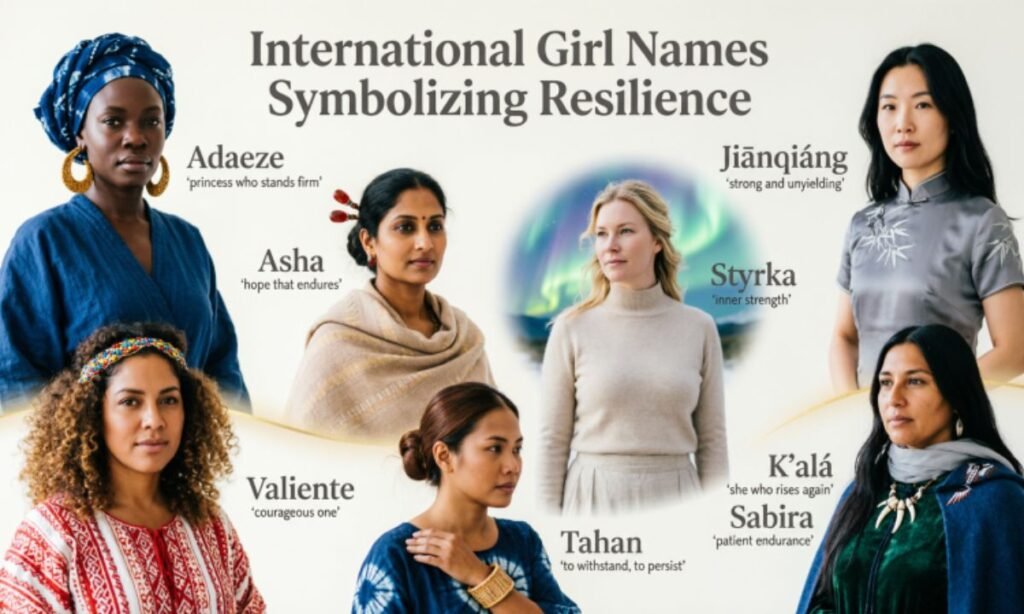
| Name | Meaning | Origin |
| Elpis | Hope; in Greek mythology, said to have remained in Pandora’s jar after everything else escaped | Greek |
| Shakti | Power, energy, a Hindu concept of divine feminine force | Sanskrit |
| Durga | Commonly interpreted as “invincible” or “unassailable”; a Hindu goddess of protection and strength | Sanskrit |
| Kali | From kala, “time”; a Hindu goddess associated with power and the destruction of evil | Sanskrit |
| Chandi | An epithet for Durga meaning “fierce,” used for her most protective form | Sanskrit |
| Vesna | Name of a spring goddess in Slavic folklore associated with renewal after winter; whether she reflects a genuine ancient deity or a later literary construction is debated among folklorists | Slavic |
| Zenobia | Meaning debated, sometimes glossed as “given life by Zeus”; known through Zenobia, the third-century warrior queen of Palmyra | Greek/Palmyrene |
| Amara | Grace, in Igbo (Nigerian); a separate, unrelated Sanskrit word amara means “immortal, eternal” | Igbo/Sanskrit |
| Sisu | Not a conventional given name, a Finnish cultural concept for stoic determination and grit. Occasionally used as a first name in Finland, but it’s a concept-word borrowing rather than an established traditional name | Finnish |
Nature-Inspired Girl Names Associated With Resilience
These carry their power almost entirely through symbolism and folklore rather than literal dictionary meaning.
| Name | Meaning | Symbolism |
| Willow | Willow tree | In folklore, admired for bending in storms without snapping |
| Fern | Fern plant | An ancient plant lineage that has survived largely unchanged for millions of years |
| Rowan | Commonly glossed as “little red one,” referencing the tree’s berries | Associated with protection in Celtic folklore |
| Briar | Thorny plant or hedge | Symbolically tied to protection because of its thorns |
| Hazel | Hazel tree | Linked to wisdom and protection in Celtic tradition |
| Laurel | Laurel tree | Tied to victory and honor; laurel wreaths crowned winners in ancient Greece and Rome |
| Juniper | Juniper shrub | Known for thriving in rocky, harsh conditions |
| Aspen | Aspen tree | Notable for its ability to regrow quickly after fire or damage |
| Cedar | Cedar tree | Long used in the Middle East and Mediterranean as a symbol of endurance |
| Sierra | Literally “saw” in Spanish, used to describe jagged mountain ranges | Carries a rugged, unyielding feel |
| Sequoia | Named after the giant redwood | Among the longest-living tree species on Earth; symbolically tied to longevity rather than strength itself |
| Terra | Earth | Grounded, elemental association |
| Coral | Named after ocean coral | An organism known for building resilient reef structures over generations |
| Flint | Hard stone historically used to start fires | Symbolically tied to toughness and spark |
Mythological & Legendary Girl Names
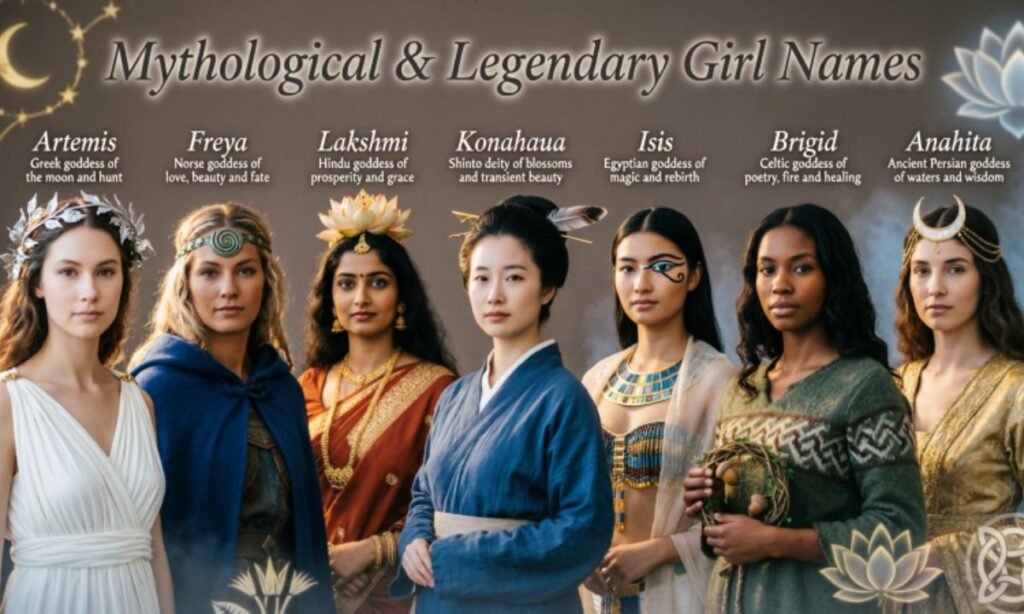
Meanings for very old mythological and Norse/Gaelic names are often reconstructed from linguistic roots rather than settled by consensus. Where scholars disagree, that’s flagged rather than resolved in favor of the most dramatic version, and a goddess’s attributes are kept separate from what her name literally means.
| Name | Meaning/Identity | Origin |
| Andraste | Commonly glossed as “the invincible one”; a goddess invoked by Boudica before battle, according to the Roman historian Cassius Dio | Ancient British/Celtic |
| Morrigan | Meaning debated; often rendered “phantom queen” or “great queen” | Irish/Gaelic mythology |
| Scathach | Often translated “the shadowy one”; a legendary warrior woman who trained heroes in combat | Irish/Scottish Gaelic mythology |
| Aoife | Commonly glossed as “beauty” or “radiance”; in Irish mythology, a formidable warrior woman who trained legendary heroes | Irish/Celtic mythology |
| Maeve (Medb) | Meaning debated, often given as “she who intoxicates”; a legendary warrior queen of Connacht known for leading her own armies | Irish/Celtic mythology |
| Skadi | Meaning debated, possibly related to Old Norse skaði (“harm”); a goddess of winter and mountains known for her independence | Old Norse |
| Enyo | Goddess of war and destruction in Greek myth | Ancient Greek |
| Bellona | From Latin bellum, “war”; Roman goddess of war | Roman mythology |
| Athena | Greek goddess of wisdom and strategic warfare | Ancient Greek |
| Minerva | Roman goddess of wisdom and strategic warfare, closely paralleling Athena | Roman mythology |
| Hippolyta | Meaning debated, often linked to horses; an Amazon queen in Greek mythology | Greek mythology |
| Atalanta | Meaning debated, commonly associated with swiftness; a swift huntress and warrior in Greek mythology | Greek mythology |
| Antigone | Meaning debated, sometimes read as “unbending” or “in place of a mother”; a Greek tragic heroine remembered for defying authority to honor her principles | Greek mythology |
| Sekhmet | “The powerful one”; a lioness-headed goddess of war and healing | Ancient Egyptian |
| Neith | One of the oldest deities in the Egyptian pantheon, associated with war and hunting | Ancient Egyptian |
How to Choose a Name That Feels Right
Start with the specific feeling you want, not just a keyword. “Survivor,” “warrior,” and “resilient” get grouped together on lists like this one, but they’re not interchangeable: a name meaning “victorious” carries a different tone than one meaning “she who endures.” Sit with which one fits your reason for looking.
Decide how literal you want the meaning to be. Some parents want the connection obvious even to strangers, so they lean toward names that translate directly to “strength” or “victory.” Others prefer something quieter, a documented meaning that isn’t widely known, so it becomes a private detail shared only when they choose to.
Say it out loud, with your last name, the way a teacher would read it off a roster. A beautiful meaning doesn’t fix an awkward pairing.
Decide whether cultural origin matters to you. Some parents want a name from their own heritage or faith tradition; others are choosing on meaning and sound alone, with no cultural tie required.
Do the sibling and middle-name test. A name that stands beautifully alone can feel mismatched next to an existing sibling’s name in style or era.
And give yourself permission to prioritize sound over meaning, or the reverse: meaning is one input, not the whole decision.
Final Thoughts
Finding the right name is about more than its meaning; it’s also about the strength, hope, or courage you want it to represent. As you narrow down your choices, consider each name’s origin, pronunciation, and how naturally it fits your family’s culture and traditions.
Say your favorite names out loud alongside your last name, and notice which ones feel right to you. If you’re torn between a meaningful name and one you simply love hearing, take your time and choose the one that feels most personal.
Frequently Asked Questions
What girl name means survivor?
No traditional feminine name translates literally to “survivor.” Names tied to strength, endurance, victory, or renewal, like Valentina, Nike, or Perpetua, are commonly used to express that idea instead.
What girl names mean strength?
Matilda (“mighty in battle”), Valeria and Valentina (“strong”), Adira (“strong, mighty”), and Gertrude (“spear of strength”) all carry literal strength meanings rooted in their original languages.
What girl names mean resilient or courageous?
Andrea and Andra both derive from the Greek word for courage. Leona and Leonie (“lioness”) lean on lion symbolism rather than a literal courage meaning. Endurance is a direct English virtue name.
What names symbolize survival without meaning it literally?
Phoenix (rebirth from ashes), Ivy (an evergreen that persists), Sabra (a cactus tough outside and soft within), and Willow (bending without breaking) are all symbolic rather than literal choices.
What girl names mean warrior or protector?
Alexandra (“defender of the people”), Hildegard (“battle stronghold”), and Wilhelmina (“resolute protection”) carry warrior or protector meanings directly in their etymology.
Are there any names that literally mean survivor?
Not in the major naming traditions surveyed here. The closest matches come from words for life, strength, victory, or endurance rather than “survivor” itself.
How do I choose a name that represents survival?
Start with the specific quality you want: strength, courage, endurance, victory, or renewal. Then check the name’s pronunciation, cultural background, and how it sounds with your surname.
