

Gray doesn’t announce itself. It’s the color of wolf fur, river stones, morning fog, and the first silver in a grandparent’s hair. That quiet quality is why a gray-linked name can feel calm, a little mysterious, and strong without trying.
Here are 296 names that mean gray or are tied to it, for girls, boys, and everyone in between. Very few names actually translate to “gray,” so each one is sorted by how it connects: a literal meaning, a link to silver or ash, or a symbolic association with things like stone, wolves, mist, and moonlight.
How These Names Connect to Gray
Most names earn the connection indirectly, so the lists below fall into three groups:
- Literal: the name’s established meaning is gray, gray-haired, or gray-eyed.
- Associated: the name refers to silver, ash, or a similar shade or material.
- Symbolic: the meaning is something we picture as gray, such as stone, wolves, mist, doves, moonlight, or the wisdom of age. The meaning itself isn’t “gray.”
Where an etymology is debated, the table says so.
Names That Literally Mean Gray or Gray-Haired
| Name | Meaning | Origin | Usage |
| Gray | “Gray,” from Old English grǣg; began as a nickname or surname for a gray-haired person | English | Unisex |
| Grayson | “Son of Gray” | English | Boy |
| Floyd | English form of Welsh Llwyd, “gray” | Welsh/English | Boy |
| Lloyd | From Welsh llwyd, “gray” (sometimes “brown” or “holy” in older sources) | Welsh | Boy |
| Griselda | Commonly explained as Germanic gris “gray” + hild “battle”; the etymology is debated | Germanic | Girl |
| Glaucus | From Greek glaukos, “gleaming” or “bluish-gray”; a Greek sea god | Greek | Boy |
| Glauce | Feminine counterpart of Glaucus; borne by several women in Greek myth | Greek | Girl |
| Glaucon | From the same Greek root as Glaucus; the name of Plato’s brother | Greek | Boy |
| Griswold | Commonly explained as Old French gris “gray” + a Germanic word for “forest”; mainly a surname | French/Germanic | Boy |
| Bozkurt | “Gray wolf” (boz “gray” + kurt “wolf”); also tied to a Turkish nationalist movement, so context matters | Turkish | Boy |
| Ashhab | Arabic ashhab, “grayish,” often used of horses | Arabic | Boy |
| Börte | Often glossed as “blue-gray”; sources vary. Wife of Genghis Khan | Mongolian | Girl |
| Liath | “Gray” (liath); the name of the gray horse Liath Macha in Irish myth | Gaelic | Unisex |
| Liadan | “Gray lady,” from liath | Irish | Girl |
Names Associated With Silver, Ash, and Gray Metals
Silver and Steel Names
| Name | Meaning | Origin | Usage |
| Silver | The metal and its pale gray sheen | English | Unisex |
| Argent | “Silver”; also the heraldic term | Latin/French | Unisex |
| Argentina | “Of silver” | Latin | Girl |
| Arian | “Silver” (arian) | Welsh | Unisex |
| Arianwen | “Silver” + “fair, blessed” | Welsh | Girl |
| Arianrhod | “Silver wheel”; a goddess in Welsh myth | Welsh | Girl |
| Argyris | From argyros, “silver” | Greek | Boy |
| Argyro | Feminine form of Argyris | Greek | Girl |
| Asimina | From asimi, “silver” | Greek | Girl |
| Argenta | “Silver”; rare | Latin | Girl |
| Jumana | “Silver pearl” or “pearl” | Arabic | Girl |
| Lujain | “Silver” | Arabic | Girl |
| Simin | “Silvery” | Persian | Girl |
| Simindokht | “Silvery girl” (simin + dokht, “daughter” or “girl”) | Persian | Girl |
| Rajat | “Silver” | Sanskrit/Hindi | Boy |
| Srebrenka | From Slavic srebro, “silver” | Slavic | Girl |
| Gümüş | “Silver” | Turkish | Girl |
| Gin | “Silver” (with the kanji 銀) | Japanese | Unisex |
| Nuada | Irish king “of the silver hand” (Airgetlám); the name’s own meaning is uncertain | Irish | Boy |
| Sterling | Origin uncertain: either “little star” or the silver coin standard | English | Boy |
| Steele | From “steel,” a gray metal; a surname-style name | English | Boy |
| Stahl | “Steel” | German | Boy |
| Tetsu | “Iron” (with the kanji 鉄) | Japanese | Boy |
| Pewter | The soft gray tin alloy; a word-name | English | Unisex |
| Galena | “Lead ore,” the silvery-gray mineral | Latin | Girl |
Ash Names
| Name | Meaning | Origin | Usage |
| Ash | Named for the ash tree (not the color), though ash-gray is the obvious echo | English | Unisex |
| Ashby | “Ash-tree farm” | English/Norse | Boy |
| Ashton | “Ash-tree town” | English | Unisex |
| Ashford | “Ford by the ash trees” | English | Boy |
| Ashley | “Ash-tree clearing” | English | Unisex |
| Ashcroft | “Ash-tree field” | English | Boy |
| Ashworth | “Ash-tree enclosure” | English | Boy |
| Ashbourne | “Stream where ash trees grow” | English | Boy |
| Ashdown | “Ash-tree hill” | English | Boy |
| Ashmore | “Pond among the ash trees” | English | Boy |
| Askr | “Ash tree”; the first man in Norse myth | Old Norse | Boy |
| Cinder | A word-name for burnt ash | English | Unisex |
| Cinderella | “Little cinder girl,” from French Cendrillon | French/English | Girl |
| Ember | A glowing coal that burns down to ash | English | Unisex |
| Sumi | “Ink” or “charcoal,” depending on the kanji | Japanese | Unisex |
| Dhumavati | From dhuma, “smoke”; a Hindu goddess | Sanskrit | Girl |
Names Symbolically Connected to Gray
Stone and Rock Names
Stone is one of nature’s most familiar grays. None of these names mean “gray” themselves.
| Name | Meaning | Origin | Usage |
| Peter | “Rock” or “stone” | Greek | Boy |
| Petra | Feminine of Peter | Greek | Girl |
| Piers | Norman French form of Peter | French/English | Boy |
| Pierre | French form of Peter | French | Boy |
| Pedro | Spanish and Portuguese form of Peter | Spanish | Boy |
| Pietro | Italian form of Peter | Italian | Boy |
| Pietra | “Stone” | Italian | Girl |
| Petros | Greek form of Peter | Greek | Boy |
| Perrin | Old French diminutive of Pierre | French | Boy |
| Petronella | From the Roman family name Petronius, possibly “rock” | Latin | Girl |
| Stone | Direct word-name | English | Boy |
| Stein | “Stone” | Norse/German | Boy |
| Sten | “Stone” | Swedish | Boy |
| Torsten | “Thor’s stone” | Scandinavian | Boy |
| Steinar | “Stone warrior” | Old Norse | Boy |
| Steen | “Stone” | Danish/Dutch | Boy |
| Steiner | “Stone worker” or “mason” | German | Boy |
| Stanley | “Stone clearing” | Old English | Boy |
| Stanton | “Stone settlement” | Old English | Boy |
| Stanford | “Stone ford” | Old English | Boy |
| Stanfield | “Stony field” | Old English | Boy |
| Stanhope | “Stony valley” | Old English | Boy |
| Stannard | “Stone-hard” | Old English | Boy |
| Dunstan | “Dark stone” (dunn + stan) | Old English | Boy |
| Hallam | A place name meaning roughly “at the rocks” | Old English | Boy |
| Rockwell | “Rocky spring” or “rocky well” | English | Boy |
| Tor | “Rocky hill”; also a Scandinavian short form of Thor | English/Norse | Boy |
| Craig | “Rock” or “crag” | Scottish Gaelic | Boy |
| Carrick | “Rock” | Gaelic | Boy |
| Cairn | A heap of stones used as a marker | Scottish Gaelic | Unisex |
| Cashel | “Stone ring-fort,” from caiseal | Irish | Boy |
| Cliff | “Steep rock face” | English | Boy |
| Clive | “Cliff” or “slope” | Old English | Boy |
| Ebenezer | “Stone of help” | Hebrew | Boy |
| Eben | “Stone” (even) | Hebrew | Boy |
| Tzur | “Rock” | Hebrew | Boy |
| Tzuriel | “God is my rock” | Hebrew | Boy |
| Cephas | “Rock” (kepha); a New Testament name for Peter | Aramaic | Boy |
| Kaya | “Rock”; the name also arises independently in other cultures | Turkish | Unisex |
| Granit | From the word for granite | Albanian | Boy |
| Granite | The hard gray rock | English | Unisex |
| Kamen | “Stone” | Bulgarian | Boy |
| Kivi | “Stone” | Finnish | Unisex |
| Shila | “Rock” or “stone” (shila) | Sanskrit | Girl |
| Sakhr | “Rock” | Arabic | Boy |
| Ishi | “Stone” (with the kanji 石) | Japanese | Unisex |
| Iwao | “Rock” or “boulder” | Japanese | Boy |
| Seok | “Stone” (with the hanja 石) | Korean | Boy |
| Slate | The gray rock | English | Unisex |
| Slater | Occupational surname for a roof slater | English | Boy |
| Flint | The hard gray stone | English | Boy |
| Ashlar | Squared, finely cut building stone | English | Boy |
| Pebble | A small, smooth stone | English | Girl |
| Rochelle | “Little rock,” from the French place name | French | Girl |
Wolf Names
Gray is the wolf’s classic color in folklore. These names mean “wolf,” not “gray.”
| Name | Meaning | Origin | Usage |
| Wolf | “Wolf” | Germanic | Boy |
| Wolfgang | “Wolf path” or “wolf journey” | German | Boy |
| Wolfram | “Wolf raven” | German | Boy |
| Wulfstan | “Wolf stone” | Old English | Boy |
| Wulfric | “Wolf ruler” | Old English | Boy |
| Ulf | “Wolf” | Old Norse | Boy |
| Ulric | Either “wolf ruler” (Old English) or “prosperous ruler” (Germanic) | English/German | Boy |
| Varg | “Wolf” | Scandinavian | Boy |
| Fenrir | The monstrous wolf of Norse myth; “fen-dweller” | Old Norse | Boy |
| Rolf | From Hrólfr, “famous wolf” | Old Norse | Boy |
| Rudolph | “Famous wolf” | Germanic | Boy |
| Ralph | “Wolf counsel” | Old English/Norse | Boy |
| Raoul | French form of Ralph, “wolf counsel” | French | Boy |
| Randolph | “Shield wolf” | Old English | Boy |
| Arnulf | “Eagle wolf” | Germanic | Boy |
| Lowell | “Little wolf,” from Old French lovel | French | Boy |
| Conan | Usually “little hound”; some sources link it to wolves | Irish | Boy |
| Conall | “Strong wolf” | Irish | Boy |
| Faolan | “Little wolf” | Irish | Boy |
| Bleddyn | “Wolf cub” (from blaidd) | Welsh | Boy |
| Blaidd | “Wolf” | Welsh | Boy |
| Zeev | “Wolf” | Hebrew | Boy |
| Ylva | “She-wolf” | Swedish/Norse | Girl |
| Lupa | “She-wolf” | Latin | Girl |
| Lupo | “Wolf” | Italian | Boy |
| Loba | “She-wolf,” used mostly as a word | Spanish | Girl |
| Lobo | “Wolf”; mainly a surname | Spanish/Portuguese | Boy |
| Lycus | From lykos, “wolf” | Greek | Boy |
| Vuk | “Wolf” | Serbian | Boy |
| Farkas | “Wolf” | Hungarian | Boy |
| Kurt | “Wolf” in Turkish; separately, a German short form of Konrad | Turkish/German | Boy |
| Börü | “Wolf” | Old Turkic | Unisex |
| Asena | The legendary she-wolf of Turkic origin stories | Turkic | Girl |
| Amarok | A giant wolf in Inuit tradition | Inuit | Unisex |
| Wayah | Reported as “wolf” | Cherokee | Unisex |
| Mahigan | Reported as “wolf” | Algonquian | Unisex |
Mist, Cloud, Rain, and Storm Names
These evoke overcast skies. Their meanings are about weather or sky, not the color.
| Name | Meaning | Origin | Usage |
| Mist | “Mist”; a Valkyrie in Norse myth | Old Norse | Unisex |
| Misty | “Covered in mist”; a modern word-name | English | Girl |
| Kasumi | “Mist” or “haze” | Japanese | Girl |
| Nephele | “Cloud”; a nymph in Greek myth | Greek | Girl |
| Skye | From the Isle of Skye; one theory links it to an Old Norse word for cloud | Scottish | Girl |
| Sora | “Sky” (with the usual kanji) | Japanese | Unisex |
| Cielo | “Sky” | Spanish/Italian | Girl |
| Celeste | “Heavenly” | Latin | Girl |
| Rain | The weather | English | Unisex |
| Storm | The weather | English | Unisex |
| Tempest | “Storm” | Latin/English | Unisex |
| Thor | “Thunder”; Norse thunder god | Old Norse | Boy |
| Raiden | “Thunder and lightning” | Japanese | Boy |
| Indra | Vedic god of rain and thunder; meaning uncertain | Sanskrit | Boy |
| Zephyr | “West wind” | Greek | Boy |
| Gale | Short form of Abigail, or from the word for a strong wind | English | Unisex |
| Boreas | “North wind” | Greek | Boy |
| Aella | “Whirlwind” or “storm-swift”; an Amazon in Greek myth | Greek | Girl |
| Amaya | Japanese “night rain”; also, separately, Basque “the end” | Japanese/Basque | Girl |
| Mizore | “Sleet” | Japanese | Girl |
| Vesper | “Evening” | Latin | Unisex |
| Aura | “Breeze” | Greek | Girl |
Fog, Cloud, and Rain Names From Around the World
| Name | Meaning | Origin | Usage |
| Haze | Light mist or smoke in the air | English | Unisex |
| Cloud | The sky word | English | Unisex |
| Nebula | “Mist” or “cloud” | Latin | Girl |
| Nimbus | “Rain cloud” | Latin | Unisex |
| Mistral | A cold wind of southern France; from a word meaning “masterful” | Occitan | Unisex |
| Kiri | “Fog” or “mist” (with the kanji 霧) | Japanese | Girl |
| Kumo | “Cloud” (with the kanji 雲) | Japanese | Unisex |
| Ame | “Rain” (with the kanji 雨) | Japanese | Unisex |
| Shigure | A cold autumn drizzle | Japanese | Unisex |
| Noelani | “Heavenly mist” | Hawaiian | Girl |
| Yun | “Cloud” (with the usual character) | Chinese | Unisex |
| Pilvi | “Cloud” | Finnish | Girl |
| Bulut | “Cloud” | Turkish | Unisex |
| Megha | “Cloud” | Sanskrit | Girl |
| Varsha | “Rain” | Sanskrit | Girl |
| Yağmur | “Rain” | Turkish | Girl |
| Baran | “Rain” | Turkish/Persian | Unisex |
| Ghayth | “Rain,” especially welcome rain | Arabic | Boy |
Storm and Thunder Gods
| Name | Meaning | Origin | Usage |
| Parjanya | Vedic god of rain and thunderclouds | Sanskrit | Boy |
| Perun | Slavic god of thunder and lightning | Slavic | Boy |
| Taranis | “Thunderer”; a Celtic thunder god | Celtic | Boy |
| Aeolus | Keeper of the winds in Greek myth; “quick-moving” | Greek | Boy |
| Ukko | Finnish god of sky and thunder; also the word for “old man” | Finnish | Boy |
| Oya | Yoruba orisha of storms and wind | Yoruba | Girl |
| Shango | Yoruba orisha of thunder | Yoruba | Boy |
| Susanoo | Shinto god of storms and the sea | Japanese | Boy |
| Raijin | Shinto god of thunder | Japanese | Boy |
Dusk and Twilight Names
The half-light between day and night is a soft, gray hour.
| Name | Meaning | Origin | Usage |
| Dusk | Twilight; a word-name | English | Unisex |
| Hesper | “Evening” or “evening star” | Greek | Unisex |
| Sandhya | “Twilight” | Sanskrit | Girl |
Moon and Moonlight Names
Moonlight is pale and silvery, which puts these names close to gray. None of them mean “gray.”
| Name | Meaning | Origin | Usage |
| Luna | “Moon” | Latin | Girl |
| Selene | Greek goddess of the moon | Greek | Girl |
| Artemis | Greek moon and hunt goddess; Homer calls her “silver-bowed”; the name’s meaning is uncertain | Greek | Girl |
| Diana | Roman moon goddess; usually explained as “heavenly” or “divine” | Latin | Girl |
| Phoebe | “Bright” or “radiant”; also an epithet of a moon goddess | Greek | Girl |
| Cynthia | “From Mount Cynthus”; an epithet of Artemis | Greek | Girl |
| Chandra | “Moon” | Sanskrit | Unisex |
| Chandni | “Moonlight” | Hindi | Girl |
| Indu | “Moon” | Sanskrit | Girl |
| Shashi | “Moon” | Sanskrit | Unisex |
| Soma | “Moon” in Sanskrit; also a sacred drink and deity in Vedic texts | Sanskrit | Unisex |
| Mani | “Moon”; the moon personified in Norse myth | Old Norse | Boy |
| Tsuki | “Moon” | Japanese | Unisex |
| Yue | “Moon” (with the usual character 月) | Chinese | Unisex |
| Mahina | “Moon” | Hawaiian | Girl |
| Marama | “Moon” or “light” | Māori | Unisex |
| Qamar | “Moon” | Arabic | Unisex |
| Badr | “Full moon” | Arabic | Boy |
| Hilal | “Crescent moon” | Arabic | Unisex |
| Mahtab | “Moonlight” | Persian | Girl |
| Ayla | “Moonlight” or “halo around the moon” | Turkish | Girl |
| Ilargi | “Moon” | Basque | Girl |
Dove and Heron Names
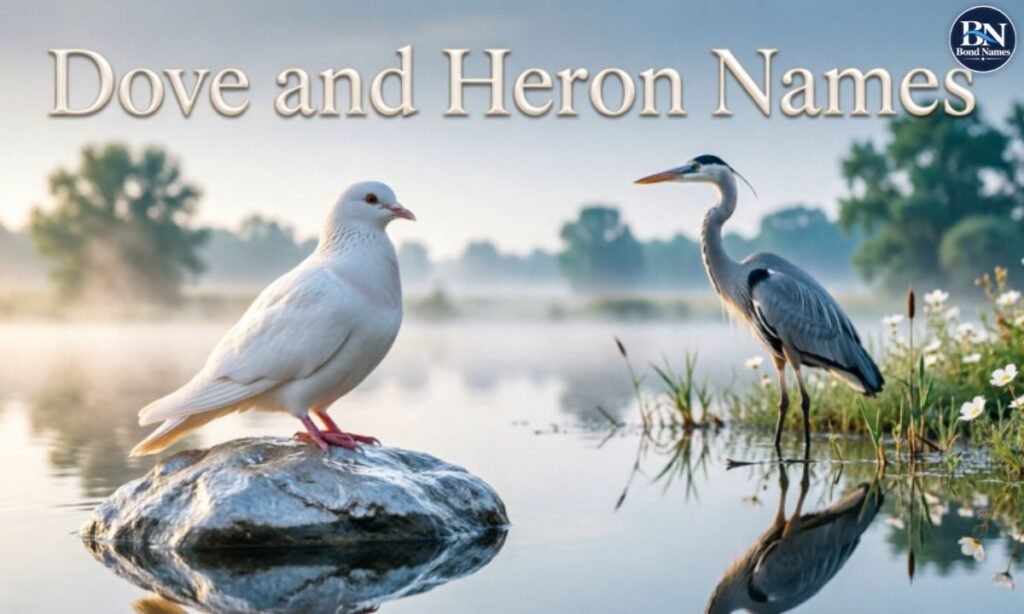
Many doves are soft gray, and so are many herons, which is the link here.
| Name | Meaning | Origin | Usage |
| Dove | The bird | English | Girl |
| Paloma | “Dove” | Spanish | Girl |
| Colomba | “Dove” | Italian | Girl |
| Columba | “Dove” | Latin | Unisex |
| Columbus | “Dove” (masculine form) | Latin | Boy |
| Columbine | “Dove-like”; also the flower | Latin/French | Girl |
| Colm | Irish form of Columba | Irish | Boy |
| Peristera | “Dove” | Greek | Girl |
| Jonah | “Dove” (yonah) | Hebrew | Boy |
| Yonina | “Dove” | Hebrew | Girl |
| Jemima | Traditionally “dove”; the etymology is debated | Hebrew | Girl |
| Heron | The long-legged wading bird, often gray | Old French/English | Unisex |
Wisdom and Age Names
Gray hair has long signaled age and experience, so these names are tied to being old or wise. They’re associations, not translations of “gray.”
| Name | Meaning | Origin | Usage |
| Alden | “Old friend” | Old English | Boy |
| Aldwin | “Old friend” | Old English | Boy |
| Aldo | “Old” | Germanic | Boy |
| Aldous | Germanic element meaning “old” | English | Boy |
| Aldric | “Old ruler” | Germanic | Boy |
| Senan | From Irish sean, “old” | Irish | Boy |
| Elder | “Older” or “senior” | English | Unisex |
| Seneca | From a Roman family name tied to senex, “old man” | Latin | Unisex |
| Odin | Norse god, from a word meaning “frenzy”; pictured as a gray-bearded wanderer | Old Norse | Boy |
| Sage | “Wise,” also the herb | English | Unisex |
| Sophia | “Wisdom” | Greek | Girl |
| Sibyl | A prophetess in Greek tradition | Greek | Girl |
| Minerva | Roman goddess of wisdom | Latin | Girl |
| Athena | Greek goddess of wisdom, with the epithet glaukopis, “gray-eyed” | Greek | Girl |
| Saga | “Story”; also a Norse goddess | Old Norse | Girl |
| Saraswati | Hindu goddess of knowledge and learning | Sanskrit | Girl |
| Solomon | From shalom, “peace”; the biblical king known for wisdom | Hebrew | Boy |
| Hakeem | “Wise” | Arabic | Boy |
| Nestor | The wise elder king in the Iliad; the meaning is uncertain | Greek | Boy |
| Zhi | “Wisdom” (with the usual character) | Chinese | Unisex |
| Medha | “Wisdom, intelligence” | Sanskrit | Girl |
| Prajna | “Wisdom” | Sanskrit | Girl |
| Hikmat | “Wisdom” | Arabic | Unisex |
| Metis | “Wisdom, counsel”; a Titaness | Greek | Girl |
| Alim | “Knowing, learned” | Arabic | Boy |
Sages, Seers, and Wise Figures
| Name | Meaning | Origin | Usage |
| Nereus | The “old man of the sea” in Greek myth | Greek | Boy |
| Proteus | Another “old man of the sea,” a prophetic shape-shifter | Greek | Boy |
| Tiresias | The blind prophet of Thebes | Greek | Boy |
| Solon | Athenian lawgiver counted among the Seven Sages; meaning uncertain | Greek | Boy |
| Sophocles | “Famed for wisdom” | Greek | Boy |
| Mentor | The wise adviser in Homer’s Odyssey | Greek | Boy |
| Mimir | Norse keeper of wisdom; meaning debated | Old Norse | Boy |
| Kvasir | A being of great wisdom in Norse myth | Old Norse | Boy |
| Snotra | Norse goddess of wisdom; related to a word for “clever” | Old Norse | Girl |
| Thoth | Egyptian god of wisdom and writing | Egyptian | Boy |
| Seshat | Egyptian goddess of writing and knowledge | Egyptian | Girl |
| Ogma | Irish god linked to eloquence and learning | Irish | Boy |
| Fintan | A legendary Irish sage; often explained as “white” + “old,” though sources vary | Irish | Boy |
| Taliesin | Legendary Welsh bard; “radiant brow” | Welsh | Boy |
| Cerridwen | Welsh goddess of wisdom and inspiration; meaning uncertain | Welsh | Girl |
| Vidur | “Wise”; a sage in the Mahabharata | Sanskrit | Boy |
| Kavi | “Poet” or “sage” | Sanskrit | Unisex |
| Rishi | “Sage” or “seer” | Sanskrit | Boy |
Wisdom Names From Around the World

| Name | Meaning | Origin | Usage |
| Aqil | “Intelligent, wise” | Arabic | Boy |
| Fahim | “Intelligent, learned” | Arabic | Boy |
| Arif | “Knowledgeable, wise” | Arabic | Boy |
| Basira | “Insightful, perceptive” | Arabic | Girl |
| Danish | “Knowledge, wisdom” | Persian/Urdu | Boy |
| Dana | “Wise” in Persian; the name also has separate roots in other languages | Persian | Unisex |
| Bilge | “Wise, sage” | Turkish | Unisex |
| Binah | “Understanding” | Hebrew | Girl |
| Prudence | “Foresight, good judgment” | Latin | Girl |
| Hekima | “Wisdom” | Swahili | Girl |
| Panya | “Wisdom” | Thai | Unisex |
| Minh | “Bright, clever” | Vietnamese | Unisex |
| Zhe | “Wise” (with the usual character 哲) | Chinese | Unisex |
| Vidya | “Knowledge” | Sanskrit | Girl |
| Buddhi | “Intellect, wisdom” | Sanskrit | Girl |
| Gyan | “Knowledge, wisdom” | Hindi/Sanskrit | Unisex |
| Vivek | “Discernment, wisdom” | Sanskrit | Boy |
| Viveka | Feminine form of Vivek | Sanskrit | Girl |
| Satoshi | “Wise, quick-witted” (with the usual kanji) | Japanese | Boy |
| Satoru | “Enlightened, wise” | Japanese | Boy |
| Chie | “Wisdom” | Japanese | Girl |
| Jihye | “Wisdom, grace” | Korean | Girl |
How to Choose a Gray-Inspired Name
- Decide what gray means to you. The color itself, wisdom, calm, stone, moonlight, and storm clouds each point to a different section above.
- Check the actual meaning. A name on a gray list isn’t always gray by definition, so read the Meaning column before you commit.
- Say it out loud. Try the full name in a sentence. Welsh, Old Norse, and Gaelic names often aren’t pronounced the way they’re spelled.
- Think about nicknames early. See what the name naturally shortens to, and whether you’d be happy with that version.
- Picture it at every age. Imagine a child, a teenager, and an adult introducing themselves with it.
Middle Name and Sibling Ideas
These pairings are just suggestions, and they aren’t counted among the 296.
Middle names: A short, familiar name balances a distinctive first name. Try Grayson James, Argent Rose, Ashby Wren, or Griselda Fern.
Sibling sets: Names that share a theme without matching literally tend to feel connected. Ash and Skye, Flint and Paloma, and Wolf and Sage all work that way.
Final Thoughts
With this many options, it helps to start from one theme, such as silver, stone, wolves, or moonlight, and narrow down from there. Pay attention to how each name sounds, where it comes from, and whether its meaning is literal or symbolic, so you know exactly what you’re choosing.
Say your favorites out loud, try them with your family name, and picture them at different ages. A name that looks perfect on a list should also feel natural in a real sentence.
Frequently Asked Questions
What names literally mean gray?
Only a handful do, including Gray, Floyd, Lloyd, Glaucus, Liath, Liadan, and Bozkurt (“gray wolf”). Most “gray” names point to silver, stone, wolves, mist, moonlight, or age instead.
Is Griselda really a “gray” name?
It’s commonly explained as “gray battle,” but the etymology is debated. Treat it as likely rather than certain.
Do any names combine gray with wolves?
Yes. Bozkurt means “gray wolf” in Turkish, though it’s also linked to a nationalist movement, so context matters. Other wolf names, like Ulf or Faolan, mean “wolf” only.
Are there gray names for both boys and girls?
Yes. Gray, Ash, Silver, Slate, Liath, and Kaya are used for any gender. Others, like Petra or Arianrhod, are traditionally feminine.
Does Ashley mean gray?
No. It means “ash-tree clearing,” and it’s listed here only because of the ash connection.
Where do names that mean gray come from?
Mostly English, Welsh, Irish, Greek, Germanic, Norse, and Turkic traditions. A smaller number come from Arabic, Persian, Sanskrit, Japanese, and Mongolian sources.
How can I verify a name’s meaning?
Compare several established name references, such as Behind the Name, and be cautious when sources disagree. Rarer names often have less reliable documentation.
